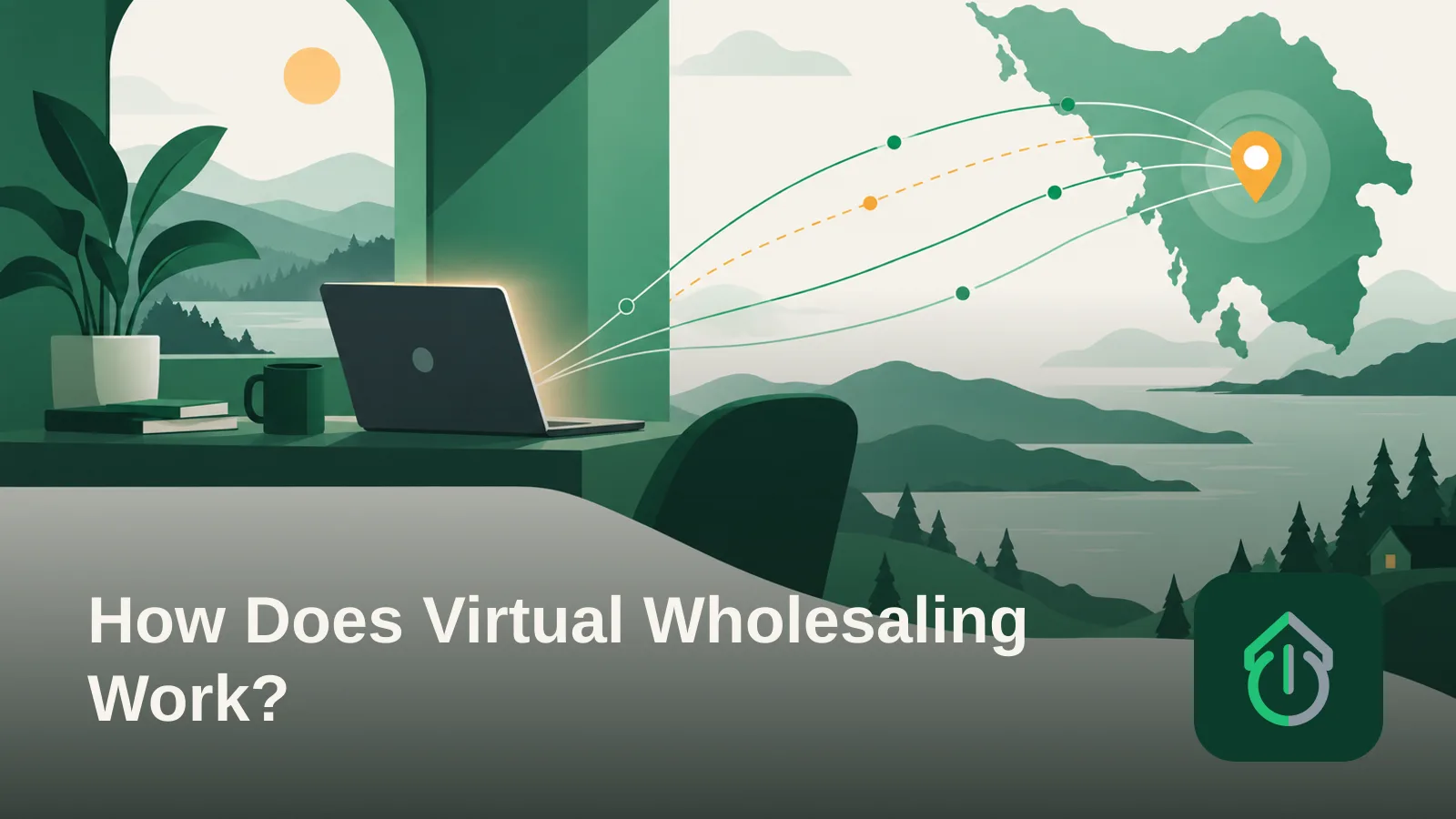
Virtual wholesaling is the practice of finding a seller, putting their property under contract, and assigning that contract to a buyer, all without ever visiting the property in person. It relies on phone and video calls, remote research, and a small local team to replace the in-person legwork of traditional wholesaling.
What Virtual Wholesaling Actually Is
Wholesaling real estate is a short-term strategy where an investor gets a property under contract with a motivated seller, then sells that contract — not the property itself — to an end buyer for a fee. "Virtual" just means the wholesaler does every step remotely: finding the lead, negotiating the contract, marketing the deal, and closing, all without setting foot on the property.
That's possible because none of the core tasks actually require physical presence. Comps can be pulled online, contracts can be e-signed, photos and video walkthroughs can be sent by a local contact, and title companies can close deals by mail or courier. Virtual wholesaling just swaps the wholesaler's own eyes and feet for a remote process and a small local team.
How It Works, Step by Step
The mechanics are the same as local wholesaling; what changes is how each step gets done without you being there.
- •Pick a target market using data instead of proximity — look at signals like elevated days on market, distressed inventory, or investor sale activity rather than only markets near you.
- •Generate leads remotely through skip tracing, cold calling, direct mail, or online lead services aimed at that market.
- •Build a small local team: a transaction coordinator or closing attorney familiar with assignable contracts, a title company comfortable with wholesale deals, and at least one trusted person who can physically walk a property and send photos or video.
- •Run the numbers using comps to estimate ARV, then back into a rehab estimate and apply the 70% rule or a similar max-offer rule to figure out the most you can offer.
- •Put the property under an assignable purchase contract, building in enough inspection time to verify condition since you're relying on someone else's eyes.
- •Market the contract to your cash buyer list — email, investor groups, or deal-sharing platforms — and negotiate your assignment fee based on the equity spread between your contract price and what a buyer will pay.
- •Assign the contract or set up a double close, and let the title company handle the paperwork and disbursement at closing.
Virtual vs. Local Wholesaling
Both versions of wholesaling end the same way — an assigned contract and a fee — but they trade off risk and reach differently.
| Factor | Local Wholesaling | Virtual Wholesaling |
|---|---|---|
| Property visits | Wholesaler walks it personally | Relies on a local contact's photos/video |
| Market reach | Limited to drivable area | Any market with usable data and a local team |
| Team needed | Often solo | Requires a trusted local partner or contractor |
| Risk of misjudging condition | Lower (you saw it) | Higher (you didn't) |
| Startup overhead | Gas, driving time | Phone/video tools, skip tracing, e-signature software |
Numbers Virtual Wholesalers Lean On
Because a virtual wholesaler can't walk every property, quick screening rules matter even more — they help filter out deals that aren't worth sending a local contact to inspect.
For rental buyers, the 1% rule (monthly rent at least 1% of price) is a fast first filter, and some wholesalers use a stricter 1.25% or even 2% version in tougher markets. The 50% rule, which assumes operating expenses eat roughly half of rent, helps sanity-check whether a deal will cash flow at all. For flip buyers, the 70% rule (or a 90% max-offer version based on ARV) sets a ceiling on what you can offer and still leave your buyer enough rehab budget and profit margin. None of these replace a full underwrite — they're just quick ways to decide whether a lead is worth the time of a remote deal.
Trade-offs and Pitfalls
Virtual wholesaling removes geographic limits, but it adds a few specific risks worth planning for.
The biggest one is condition risk. You're trusting someone else's photos, video, or description, and a rehab estimate built on incomplete information can be badly wrong — which can blow up a deal with your buyer later. Contract and real estate licensing law also varies by state; some states have specific rules about marketing a contract you don't own, so it's worth confirming what's required where you're working rather than assuming the rules are the same everywhere. Finally, a thin or untested buyer list is riskier in a market you don't know personally — if your usual buyers aren't active there, you may struggle to move the contract before your closing deadline.
Practical Takeaway
Virtual wholesaling works best as an extension of a process you've already tested, not a shortcut around learning the fundamentals. Start with one market, build a small local team you trust before you scale to a second, and keep your underwriting conservative since you're one step removed from the property. Tools that let you run comps, estimate ARV, and check days on market from anywhere make the remote side easier, but the deal still lives or dies on accurate numbers and a buyer who's ready to close.
Frequently asked questions
Is virtual wholesaling legal?
Wholesaling itself is legal in most states, but rules about marketing a contract you don't yet own vary, and some states require a real estate license for certain wholesaling activities. Confirm the specific requirements in the state where the property is located before you start marketing a deal.
Do you ever need to see the property in person?
Not necessarily, but you do need someone trustworthy who can — a contractor, agent, or photographer who walks the property and documents its condition accurately, since your rehab estimate and offer depend on that information being correct.
How do virtual wholesalers find cash buyers in a market they don't live in?
Common methods include building an online buyer list through targeted ads and investor groups, networking with local real estate agents and property managers, and using deal-marketing platforms that connect wholesalers with investors already active in that market.
What tools does virtual wholesaling typically require?
At minimum, a skip tracing or lead-generation service, a CRM to track contacts, e-signature software for contracts, and a way to run comps and estimate ARV remotely. A reliable title company or closing attorney who handles assignments is also essential.
How this post was made: the figures above come from OnOffDeals’ own market-scan data (refreshed roughly monthly); the draft was written with AI assistance and checked against that data before publishing. Everything here is an estimate to help screen deals, not financial advice.
Underwrite your next deal in about a minute
ARV from real closed sales, a rehab budget that reads the listing, HUD rent, cash flow and flip profit after every cost, with every comp shown, used or rejected. Start free. Your first week is on us.
Try OnOffDeals free