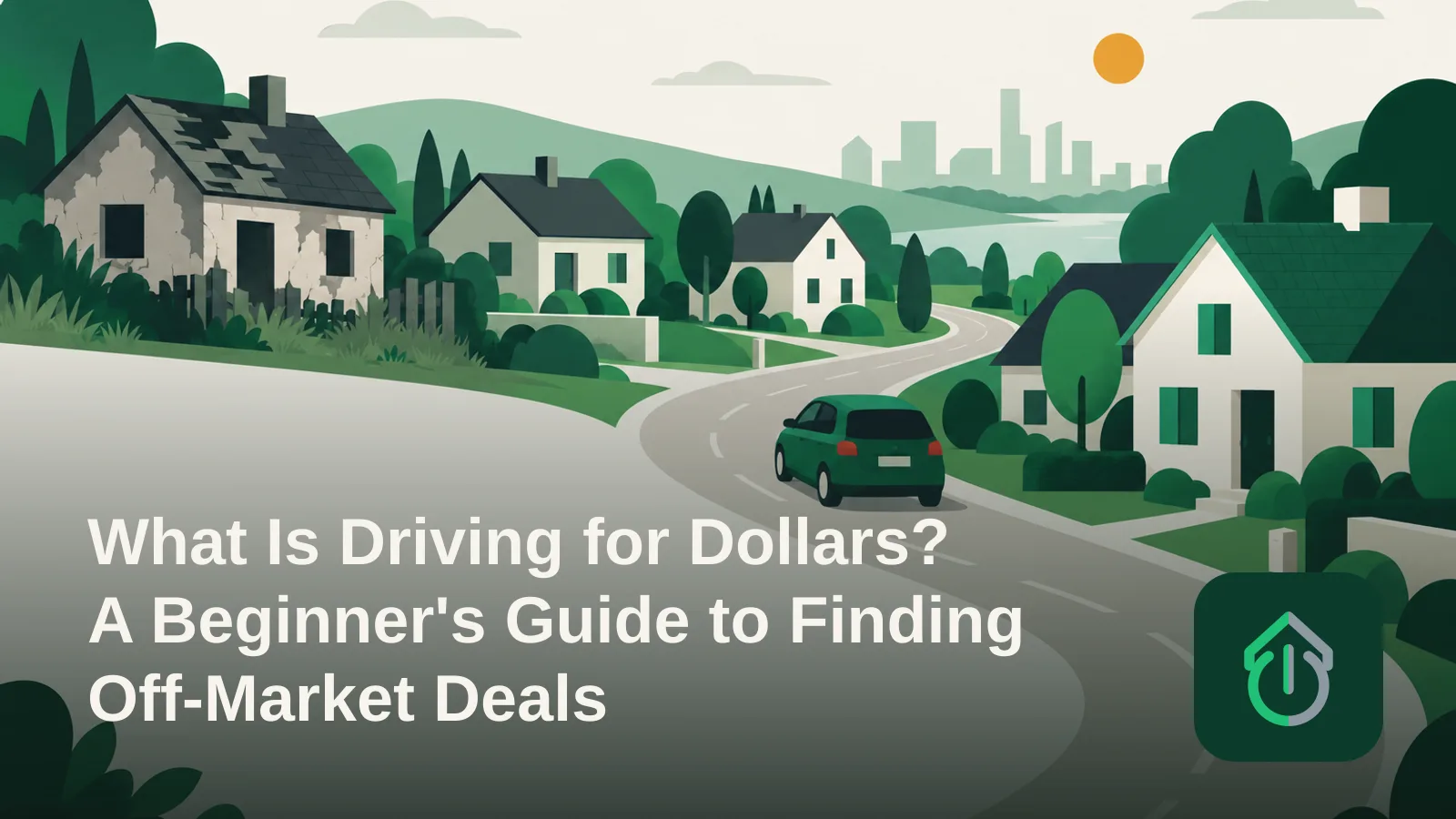
Driving for dollars is the practice of physically or virtually scouting neighborhoods to spot distressed, vacant, or neglected properties, then tracking down the owners to make direct offers before the property ever reaches the open market. It's one of the oldest ways investors source off-market deals, and it still works because most owners of neglected properties never think to list with an agent.
What Driving for Dollars Is and Why It Matters
At its core, driving for dollars means driving (or walking, or scrolling through street-view maps) through a target area and writing down addresses of properties that look neglected or vacant. The idea is simple: a property that looks distressed often has an owner who is distressed too, whether that's an absentee landlord, an heir who inherited a house they don't want, or someone who can't keep up with repairs.
It matters because these owners usually aren't working with a real estate agent. They haven't listed anywhere. If you can reach them before anyone else does, you're negotiating one-on-one instead of competing in a bidding war for an open-market listing. That's why this method remains a core tactic for finding off-market deals even as more investors turn to digital lead lists.
How Driving for Dollars Works, Step by Step
The process is straightforward, but it rewards consistency more than cleverness. Most investors who stick with it follow roughly the same sequence.
- •Pick a target area that matches your investment goals, based on research into the kind of market, price range, and property type you want.
- •Spend time in that area, in person or using mapping tools, noting any property that shows signs of distress (see the checklist below).
- •Record the address, snap a photo if you can, and jot down what you noticed about the property's condition.
- •Skip-trace the owner, meaning you look up who owns the property and find a way to reach them, through public county records, title companies, or a skip-tracing service.
- •Reach out directly, by mail, phone, or occasionally in person, explaining that you're a local investor interested in buying as-is.
- •If the owner responds, evaluate the property: estimate its ARV, build a rough rehab estimate, and calculate what you could reasonably offer using the max offer rule.
- •Check whether the deal leaves a real equity spread between your all-in cost and what the property is worth, then negotiate from there.
Signs of a Distressed or Off-Market Property
Not every unkempt lawn means a motivated seller, but certain visual cues show up again and again on properties that end up selling off-market. Treat these as prompts to investigate, not proof of anything on their own.
| Sign you notice | What it might mean |
|---|---|
| Overgrown lawn or landscaping | Possible vacancy or an absentee owner who isn't maintaining the property |
| Boarded or broken windows | Vacant property, sometimes tied to foreclosure or long-term neglect |
| Mail or newspapers piling up | Owner isn't living there regularly |
| Visible deferred maintenance (peeling paint, sagging roof, damaged siding) | Owner may lack the funds, time, or interest to keep up repairs |
| Code violation or tax notices posted | Financial or legal pressure on the owner |
| Faded or expired for-sale-by-owner sign | A past listing attempt that didn't close, which can mean the owner is still open to offers |
Trade-offs and Common Pitfalls
Driving for dollars is low-cost compared to paid lead lists or advertising, but it's not free. It takes real time behind the wheel or scrolling street view, and response rates from owners are typically low, so a handful of leads rarely turns into a deal. Treat it as a volume activity you do consistently over weeks or months, not a one-time afternoon project.
Skip tracing can also eat into your time or budget, and not every address you flag will have a traceable or responsive owner. You'll also want to be mindful of local rules: door-knocking and cold-calling are regulated in some areas, and trespassing on private property to get a closer look is never worth the risk. Finally, remember a property's curb appeal is only one data point. A well-kept house can still come with a motivated seller behind it, which is one reason many investors pair this method with searches for motivated sellers through public records or direct mail rather than relying on visual cues alone.
Practical Takeaway
Driving for dollars works best as one leg of a broader off-market strategy, not the whole plan. Once a lead turns into a real conversation, run the numbers quickly before you get emotionally attached to the deal. For a flip, that typically means comparing your estimated ARV against your rehab estimate and offer using something like the 70% or 90% max-offer frameworks. For a rental, a quick screen like the 1% rule (or a stricter 1.25% or 2% version) can tell you in seconds whether the numbers are even in the right neighborhood before you dig deeper into cap rate or cash flow.
The physical legwork finds the lead. The analysis decides whether it's actually a deal worth pursuing.
Frequently asked questions
Is driving for dollars still worth it with apps and online tools available?
Yes. Apps and street-view tools can speed up note-taking and make skip tracing easier, but the core skill, spotting distress signs and following up consistently, hasn't changed. The method still works because most neglected properties never get listed.
How do you find the owner of a vacant or distressed property?
Start with public county assessor or recorder records, which usually list the owner of record and a mailing address. If that doesn't work, a skip-tracing service or a local title company can often locate current contact information.
How many properties should I target before expecting a deal?
There's no fixed number, and response rates are typically low, so plan for volume and repeated follow-up over weeks or months rather than expecting quick results from a single pass through a neighborhood.
Is driving for dollars legal?
Driving public streets and researching public ownership records is generally fine, but rules on cold-calling, mailing, and door-knocking vary by state and locality, so check local requirements before contacting owners directly.
How this post was made: the figures above come from OnOffDeals’ own market-scan data (refreshed roughly monthly); the draft was written with AI assistance and checked against that data before publishing. Everything here is an estimate to help screen deals, not financial advice.
Underwrite your next deal in about a minute
ARV from real closed sales, a rehab budget that reads the listing, HUD rent, cash flow and flip profit after every cost, with every comp shown, used or rejected. Start free. Your first week is on us.
Try OnOffDeals free